The Brief Creative Newsletter
August 29, 2026
065 - They can't ignore you when they never heard of you
Why a consistent drumbeat matters more than any big swing, and how to build one
Speak naturally. Send without fixing.
In partnership with Wispr Flow
 It’s legit the only tool I use every. single. day.
Wispr Flow turns your voice into clean, professional text you can send the moment you stop talking. Not rough transcription you have to clean up. Actual polished text — ready for email, Slack, or any app.
Speak the way you think. Go on tangents. Change your mind mid-sentence. Flow strips the filler, fixes the grammar, and gives you text that reads like you spent five minutes writing it.
89% of messages sent with zero edits. Millions of professionals use Flow daily, including teams at OpenAI, Vercel, and Clay. Works on Mac, Windows, and iPhone.
The Spark
This is stuff I'm enjoying out in the world (it's probably not B2B).
I watched the second to last episode of Silo season 3 right before typing this (big fan of the books and show) and there was a moment that made me laugh harder than I have in a while. (mild spoilers below…)
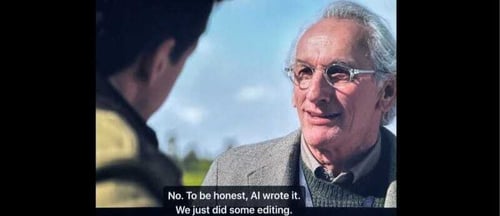 AI wrote it. We just did some editing. ss/o Talya Heller for the meme
How many of us are guilty of this? They wrote one of the show’s most important inuniverse docs using Claude. It had me cackling. That said, the show is awesome and I highly recommend catching up before season 4 arrives. Better yet, read the books!
🎵 Listening to The Blue Album by Weezer as I type this.
The Deep Thoughts
This is what I'm thinking about.
 …and it’s gonna have a ripple effect on everything
Two weeks ago I saw Foo Fighters play at Soldier Field. It was an epic three hour marathon that ended with Everlong and fireworks. Watching them play never gets old.
Over the next few days I kept thinking about what it must be like to show up for thirty years and not only deliver hit after hit like most classic rock bands too but to keep building the catalog while you do it. It’s not an easy balance to strike but Dave Grohl does a pretty damn good job at it and I think it comes from an early life experience of his.
Earlier this year I read his book The Storyteller (I like to read!). He started playing professionally at a really young age and was touring by the time he was eighteen.
All Dave wanted to do was prove that he belonged and to him that meant beating the hell out of his kit. He’d fly through drum sticks and skins. He’d throw in a drum fill wherever he could fit one in. He felt great about it but he didn’t realize that every random fill was messing with the actual music.
One day his bass player pulled him aside and told him to play the same groove, no changes, for thirty minutes straight. About 45 seconds in, Dave wanted to do something different. But he wasn’t allowed to. He wrote that those thirty minutes were some of the hardest of his life and that they taught him to respect the power of a groove.
The groove was important because it created predictability for his bandmates and the audience. They knew what to expect and could stay with it. That way when something new happened it was exciting rather than just random.
Now here’s the pivot. After that show I noticed something weird on Linkedin. People I basically never saw posting were complaining that LinkedIn is broken. No reach. No engagement. Algorithm's washed, apparently.
I'm not here to defend LinkedIn. There's plenty of things that don’t work and that's a whole separate newsletter but none of that is why “it’s broken." They actually broke it for themselves.
Here's what happens. Someone posts once, maybe twice a year. It's always some sort of "I'm thrilled to announce" post. Then when they’re done patting themselves on the back they follow it up with an actual ask. Register for this. Sign up for that. Click here. And it goes nowhere. So LinkedIn must be broken.
It’s like that friend that only asks for favors. You may help them move their couch one time but eventually you just ignore them because all they do is take. In B2B we do a lot of taking. We want emails and company data and credit card numbers but if someone is going to give us those they need to trust us first.
That's the part people skip when they blame the algorithm. Reach doesn’t happen because you showed up once or twice. It's something you build by showing up often enough that people begin to trust you. Reach, awareness, sentiment, [fill in your favorite metric], they happen because you create a steady drum beat.
Why is my brand invisible?
Most brand activity (and fwiw, when I say brand activity I mean any activity your brand takes publicly, not just brand marketing) when you actually chart it, looks like this:
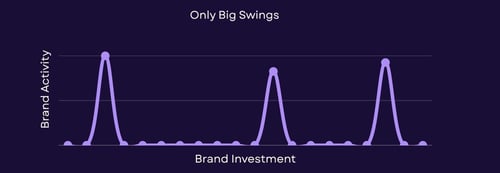 Only big swings
The team spends all of their time, energy, and budget on your major plays like your user conference or product launches with nothing happening between the milestones. It doesn’t work and the instinct is to spend harder on the next big moment or do something wilder.
And it doesn’t work for two reasons. The first is that in those moments, you are asking for something. You want them to buy a ticket or take a demo or submit a form. You’ve provided zero value outside of a landing page or video and expect the world. Nope! Second, because you’re only investing in these major milestones, your audience doesn't know you, so every swing has to reintroduce you from scratch. And if you happen to go the “do something wilder” path then it’s even harder for them to remember you because they never had familiarity in the first place (this is where the drum beat thing becomes important).
Zero activity between big moments isn't a strategy or cost savings, it's an excuse for your audience to forget you exist.
What does great look like?
What actually works looks more like this.
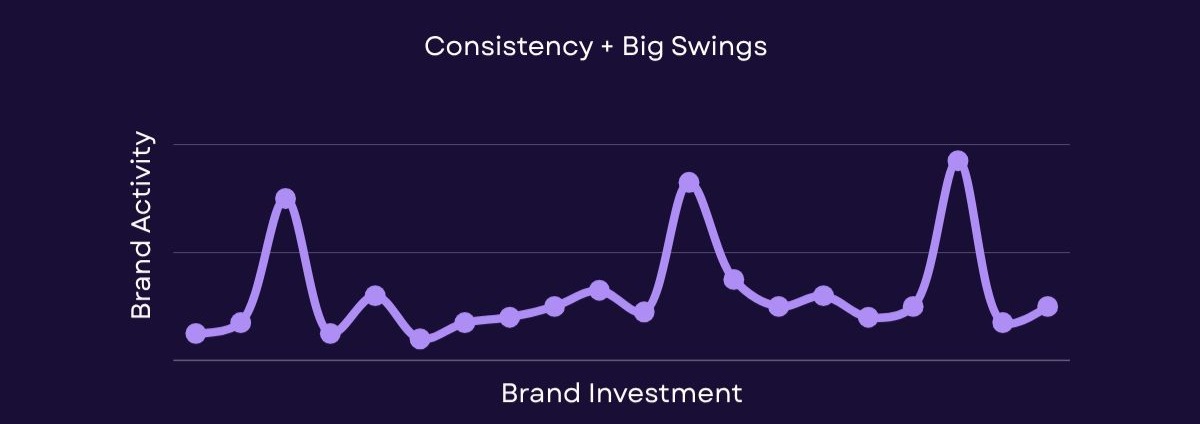
A steady drum beat doesn't come from one good post or one good episode or one good talk. It comes from being around consistently enough that when you finally do ask for something, it doesn't feel like a stranger showing up with their hand out.
The right way to do it is by creating a steady drum beat with occasional bigger swings layered on top, because you can't get people excited about something they don't already recognize.
Quick note on the steady drum beat: This isn’t an excuse to check the box and say “we did it!” A steady drum beat means you’re creating content that is valuable and educational and savable and shareable. It might be on social or a webinar or at a nice dinner. The drum beat is for you to build but the consistency and true value creation behind it is what counts.
So no, LinkedIn's not the reason those posts didn't work. The reason is those people showed up once, and expected the one time to do the job of the fifty times they didn't. And in a 95/5 world that consistency really matters.
So how do you actually do both?
You fix it by splitting the job. Your marketers own the consistency. Your creatives own the big swings. Two different jobs, two different schedules, running at the same time instead of competing for the same hours.
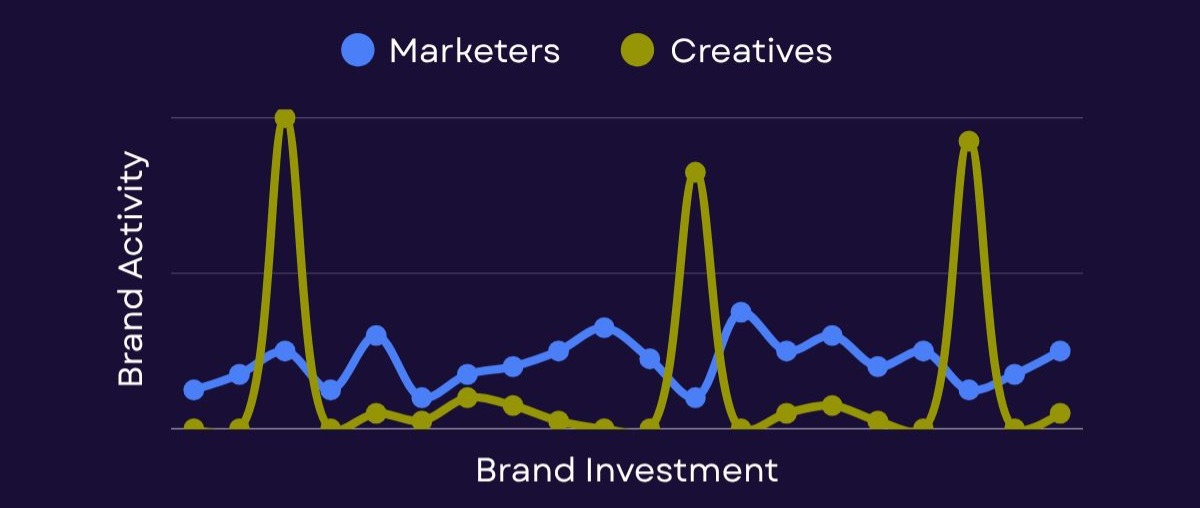
You’ll still need some marketers on the big swings. You’ll still need some creatives on the drum beat. But the point is that by thinking that it’s all one kind of work you’re sabotaging your reach, awareness, and creativity.
The split only works if showing up consistently is actually easy to do and not something that eats the same time and energy as the big campaign it's supposed to be setting up. In practice, that means having a few things in place:
- An easy-to-understand brand strategy that doesn't require a workshop to interpret every time someone wants to make something
- A scalable visual identity built with both creativity and volume in mind
- A usable design system your whole team can use without waiting on the design team
- Tools that make production fast, fully built out instances of the tools your team uses. Our creative stack is Canva, Capsule, Air, Claude, and Zapier these days.
- Training and Enablement so the tools actually get used the way they were set up to be used
- A feedback loop so the system improves instead of quietly rotting
I'd bet you already have a few of these in place. The gap is usually smaller than it feels from the inside, and it's rarely about wanting to be more consistent. It's about whether the consistent stuff is actually easy enough to produce.
And when it is, posting on Linkedin or wherever your audience is becomes so much easier and so much more rewarding for the business.