The Brief Creative Newsletter
May 23, 2026
061 - Why Scope Creep Happens
...and why it's probably your fault
Speak the email. Send the email
In partnership with Wispr Flow
Talk through your reply and get polished, professional text ready to paste. Wispr Flow strips filler, fixes grammar, and formats everything. 89% sent with zero edits. Works everywhere.
 Email, Slack, docs, I use Wispr Flow everywhere and it's so much better than typing
The Spark
This is stuff I'm enjoying out in the world (it's probably not B2B).
We’ve been traveling, we’ve been reading, we’ve been watching stuff, but if I talked about anything but the New York Knicks here I’d be lying. I’ve been a Knicks fan since before I can remember but I can’t remember it ever being this fun. The Knicks have been flying these playoffs and have wins of 51, 39, and 30 points in addition to coming back from 22 down in Game 1 of the Eastern Conference Finals. We’ll get back to non-sports related coverage soon but for now…
 Knicks are up 2-0!
If you’re really not into the sports, two articles I’ve really enjoyed this week are this interview with the new SNL cast members in Variety and the Comedy Actor’s Roundtable in The Hollywood Reporter. Both had some great sound bites but the one about not auditioning anymore has been stuck in my head all week.
🎵 Listening to Black Holes by The Blue Stones as I type this.
The Deep Thoughts
This is what I'm thinking about.
The other day I was walking the dog with Katie. We’re both business owners and we started talking about client projects—what's going well, what's going… less well. Scope creep came up. She asked a simple yet highly loaded question: where does scope creep actually comes from?
And as I started rambling it made me realize that we talk (read: complain) about scope creep all the time but we rarely stop to ask why it happens in the first place. So here we go…
 It always happens, but we can be better about dealing with it
It’s probably your fault…
I know. Nobody wants to hear that. But let's be honest about what's actually happening. More often than not the, reasons scope creep happens is because you allowed for it. And because we’re such close friends, let’s cover all of the different ways it’s probably your fault….
NOTE: When I say client, it applies to both internal clients (if you’re in-house) and external clients (if you’re a vendor).
You didn't say no. Scope creep happens because you didn't say no. Someone asked you for something, you said yes (or even worse, you said nothing), and then three weeks later you're exhausted and resentful and somehow the client is the villain. But you had a chance to draw the line and you didn't draw it. That's not on them.
The brief wasn't actually a brief. A big part of this job is figuring stuff out. We all know that but the brief isn’t one of them. Before your start work, the brief needs to be nailed down (use my intake process if you need something to get started.). If you kick off a project without a clear, agreed upon definition of what done looks like then you’re asking for scope creep because the whole project becomes an exercise of “just figuring it out” and that never happens on your timeline.
People don't understand what the work entails. And here's the thing: they're not supposed to. That's your job. Not to walk them through every step of the process, but to flag the decisions that can't be undone cheaply. There are parts of every project that are flexible—especially when working with digital assets. And then there are the things that, once they're locked, they're locked. A video shoot is a good example. You can't reshoot because someone didn't love the talent or the location after the fact. Those are the decisions that need to happen in pre-production, not post. It's your responsibility to make sure people understand which category a decision falls into before they make it. And what it’ll cost to CMD+Z.
You didn’t have the right people in the room. This one happens all the time. Sometimes it’s unclear who it should be, sometimes it’s because of calendars, and sometimes people get added to the mix, but if you don’t have a clear DACI available to everyone involved in a project (and you don’t review it during the kickoff) then you’re taking a huge risk of someone jumping into the project last second with feedback or requests you didn’t expect. Stop worrying about “people’s calendars” and get them into the right room!
And sometimes, it’s really not
It’s gotta be said. Sometimes people know exactly what they're doing. They're trying to squeeze out the last bit of toothpaste of whatever budget they have and they will keep pushing until someone pushes back. It happens but it's usually the exception, not the rule. Take accountability first.
So what do you actually do about it?
Sometimes you just say yes. If the ask is small, if it won't derail the timeline, if it will genuinely make the work better, just do it. You can call it out ("this wasn't in the brief, but I've got you") without making it a whole thing. This is your teammate. Help them out.
Pad the timeline a bit. This may sound a bit sneaky but the reality is at some point something is gonna happen. It may or may not be scope creep but regardless, if you have a bit more time, you have a bit more room to play with. If a good idea comes in and you have the space to do it, be the hero!
Make them think in trade-offs. This is the big one. In most in-house situations, the person making the request isn't spending their own budget or their own time to do the work. Asking for something is basically free. The second you introduce trade-offs, the math changes entirely because you’re giving them ownership of the decision.
It’s on you to have an honest conversation with them and explain the options. Something like “We can do this but [fill in the blank with one of the below]”
- The pet project: “[this other thing that you really care about] doesn't get done.”
- The half done: “the rest of the project scope will have to be reduced [then get into specifics]".”
- The it’s gonna be late: “the timeline is gonna be delayed by [two weeks].”
- The it’s gonna cost money: “we’ll need to bring in external help which costs [ONE BILLION DOLLARS].”
Then you wrap it up with a “which of those are you most comfortable with?” You're not saying no. You're putting the decision back in their hands with the full picture.
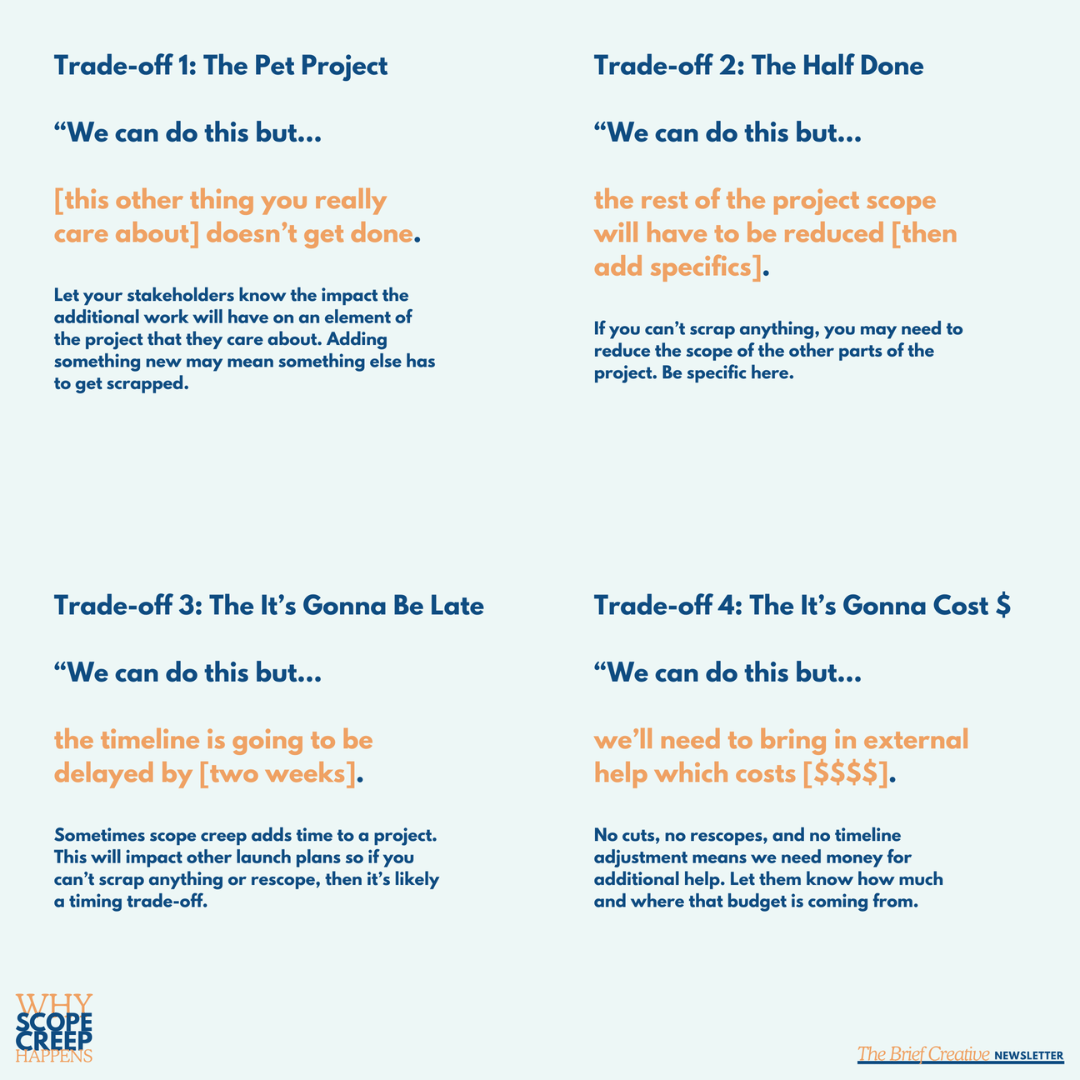 The four different types of trade-offs
Save it for v2. I know, I know v2 is a great joke. But it doesn’t have to. If you’re investing time and money into something you believe in, you should assume it’ll be successful and start thinking about what comes next. "That's a great idea, let's save it for v2" makes people feel heard, it gives them something to look forward to, and it keeps the current project on track. You're not killing the idea. You're saving it for when you can give it its full attention.
Go back to the brief together. This is probably the most underused tool in the whole list. When a new request comes in, sit down with the person and look at the original brief together. This is a great way to get you both back on the same page around goals and strategy. Ask yourselves if this new thing fits into what we set out to do? Most of the time, when people see the strategy again and see how far the work has already progressed, they talk themselves out of it if it’s not a fit. And if it is, that’s an opportunity for trade offs.
And sometimes you do just have to say no. Just not the way most people do it. "No" as a complete sentence tends to make you the villain. But there's a version of no that's actually you doing your job. If someone asks for something that would hurt the work—something that goes against the strategy, undermines the direction, or just isn't the right call—that's not you being difficult. That's you being the expert they hired. You can deliver that honestly and with care. "I hear you, and I want to be straight with you about why I don't think this is the right move." Said that way, it's not a refusal. It's expertise.
Now what?
Be prepared. Scope creep is going to happen no matter what on pretty much every project you ever work on. But rather than being reactive, you can do a lot to prevent as much of it as possible by being proactive and making sure you have a strategy documented. There’s a reason briefs are important beyond providing clarity, they also help with playing defense (and sometimes offense if something is missing). Ultimately, the more thoughtful you are in the planning stages, the less likely you’re going to get a ton of scope creep. But still maybe just a little…